Monday, November 26, 2018

"HUNCHBACK" OFFERS CINEMATIC SANCTUARY

     
          It's one of the greatest movies ever made, based on one of the greatest novels ever written.
          Reverently constructed, The Hunchback of Notre Dame (1939) sweeps away viewers to Paris a decade prior to Columbus arriving in America. 
          In keeping with Victor Hugo's 1831 novel, the film contrasts rich and poor, the powerful and the powerless, the beautiful and the monstrous. One of several standout films in a legendary movie year (Gone With the Wind and The Wizard of Oz, for example, were also released in '39), The Hunchback of Notre Dame stars the inimitable Charles Laughton in his first picture with RKO, which produced Hunchback on a massive scale. So massive, the studio built replicas in California's San Fernando Valley of not only Notre Dame Cathedral itself, but of surrounding buildings as well. So massive, that in order to keep the dust down from the cast of thousands, the studio covered the entire film set in concrete.
          There had already been an excellent film version of the story, starring Lon Chaney in the title role. Taking nothing away from the Man With a Thousand Faces, the RKO production 16 years later benefitted from movie innovations, including sound.
          Directed by William Dieterle, whose German Expressionist background accounts for the film's excellent visual aesthetic, Hunchback is the story of a beautiful young Gypsy named Esmeralda (Maureen O'Hara, perfectly cast, in her first movie) who catches the eye of all who see her--including Chief Justice Frollo (Hardwicke), the brother of Notre Dame's Archdeacon.
          Notably, in the book Frollo is the Archdeacon, and as such has taken a vow of chastity. As the Chief Justice, Frollo is required to take no such vow; his dilemma in the film therefore is entirely undercut, and this is a flaw which must be kindly overlooked. 
          To Frollo's credit, he keeps lots of cats, and is brave enough a man to hold a white cat in his sleek black raiment without benefit of a tape-roller.
          Contrasted with this cold lover of kitties who desires and cannot have Esmeralda, there is Gringoire (O'Brien), the poet, who embodies key truths of the writer's condition. "I am the true King of Fools," he remonstrates Parisians. "I battle for beauty, and the ugly gets crowned!"
          Another of the more interesting characters is Clopin, King of Beggars. Terrifically played by Thomas Mitchell (he's the forgetful Uncle Billy in It's a Wonderful Life), Clopin opines to Gringoire, "True, we're not great thieves like the nobles. Our robberies are petty compared to the wholesale plunder of the nation."
          And then there's the star of the show. When Charles Laughton plays Quasimodo, it's incredible to believe he's the same actor who brought Henry VIII, Dr. Moreau, and Capt. Bligh to life. His Hunchback has the perfect combination of "malice, astonishment, and melancholy" Hugo describes in the novel. He doesn't have many lines, but everything he says counts.
          Raised by Frollo as a foundling abandoned on the Cathedral steps, Quasimodo is almost completely deaf from ringing the huge bells of Notre Dame. Initially, he scares Esmeralda when performing Frollo's nasty bidding. But there comes a point in the story when the beautiful and persecuted Gypsy pays Quasimodo a kindness which earns his undying gratitude. 
          More than any other reason, what makes the story work is that we are the Hunchback. We are the one on the pillory. We are the one who thirsts. We are all outwardly the monster in whose breast beats the heart of a hero.
          Not one jot less true today than it was when first released, the 1939 version of The Hunchback of Notre Dame (in no way to be confused with the Disney cartoon) still stands as a high point in film, still rings plenty loud and satisfyingly clear. 


THE HUNCHBACK OF NOTRE DAME
Starring Charles Laughton,
Maureen O'Hara,
Cedric Hardwicke,
Edmond O'Brien,
Thomas Mitchell,
Alan Marshal,
Mina Gombell,
Harry Davenport
Directed by William Dieterle
Written by Sonya Levien
Based on the novel by Victor Hugo
Runtime 117 minutes


Stewart Kirby writes for
THE INDEPENDENT,
TWO RIVERS TRIBUNE,
and
ARIZONA-INDIA TIMES


Monday, November 12, 2018

"ANIMAL HOUSE" EARNS LAURELS

          Cue lofty music:
          Venerating the shining example of that noblest of institutions, the lampoon.
          It's been 40 years since Animal House was cinematically erected, and to this day more students enroll in college specifically because of it than for all other reasons combined.
          The year is 1962, the college is Faber, and the dean is Wormer (John Vernon, perfectly cast). Dean Wormer, when not readily acceding to the mayor's extortion threats, is the kind of fun-hating dean who points and says things like, "You'll get your chance, smart guy!"
          And in so doing exemplifies the poor attitude from higher education toward the heroes of Delta Tao Chi, aka Animal House.
          The star of the movie, John Belushi, was the funniest part of TV's hip hit "Saturday Night Live". He was the draw, in both cases, in a highly ensemble cast. Tom Hulce (frat pledge Pinto) played Mozart a few years later in the smash hit Amadeus, and Karen Allen traded up for Indiana Jones in Raiders of the Lost Ark.
          Also featuring Donald Sutherland as a Satan-like English prof. In a sense, the students take their education directly from none other than Hawkeye Pierce himself. Animal House resembles M*A*S*H (1970) not just as a lampoon of an institution, but in its adept use of many characters. 
          Everything about the film constantly entertains. Packed with unforgettable characters in hilarious situations, Animal House is a movie with zero down-time. Gleefully raunchy and dead-on in every way, there isn't a funnier film.
          Talk about character delineation, the dichotomy between the privileged frat house, Omega, and the mocking mockeries at Delta could not be more clear: At Delta, there's wine, women, and song. At Omega, they're consecrating the Bond of Obedience by assuming the position and paddling each other. 
          Little known fact: Douglas Kenney, the guy who plays Stork ("Well what the hell we 'sposed to do, ya mo-ron?") not only co-wrote the script, but co-founded National Lampoon magazine (1970 - 1998). A Futile and Stupid Gesture (2018), which is about Kenney, who died in an accident at age 33, can be found on Netflix.
          Harold Ramis, who also co-wrote the Animal House script, directed SNL alum Chevy Chase in National Lampoon's Vacation (1983).


ANIMAL HOUSE
Starring John Belushi,
Tom Hulce,
Stephen Furst,
Tim Matheson, 
Peter Reigert,
Karen Allen,
Mark Metcalf,
John Vernon,
Mary Louise Weller,
Martha Smith,
Donald Sutherland
Directed by John Landis
Written by Harold Ramis, 
Douglas Kenney, Chris Miller
Runtime 109 minutes
Rated R


Stewart Kirby writes for
THE INDEPENDENT
and 
TWO RIVERS TRIBUNE


Thursday, November 8, 2018

THE DEVILKILLERS audios 1, 2, 3, 4, 5, 6, 7, 8, 9, 10


THE DEVILKILLERS audio 1
https://drive.google.com/file/d/1DoB41h5WU8XinzeS5ObZOUL7ttEjJRrC/view

THE DEVILKILLERS audio 2
https://drive.google.com/file/d/1tT6nBH5RPJ3kTHuN-8odAh7aiYoLWBEj/view

THE DEVILKILLERS audio 3
https://drive.google.com/file/d/1OS0M3IPnieTkkzMYZPg3TaKH62H5yjwp/view

THE DEVILKILLERS audio 4
https://drive.google.com/file/d/1zZbS9myfQDI4N4yPmk2yFcGQQwhYMdJS/view

THE DEVILKILLERS audio 5
https://drive.google.com/file/d/1rBdmWXiqseKz951PkYURp81AWFFCmjPQ/view

THE DEVILKILLERS audio 6
https://drive.google.com/file/d/1wdoScuub7USSbmtmhJKVXN96IwCjx74Y/view

THE DEVILKILLERS audio 7
https://drive.google.com/file/d/1Y-hiNB9Pt4s2JHom7LhfHWuTl5fkWfc9/view

THE DEVILKILLERS audio 8
https://drive.google.com/file/d/1amu06aFm_zmHTmplNT1l_nPXB7758j9i/view

THE DEVILKILLERS audio 9
https://drive.google.com/file/d/1wsL1FDi8Zi5M70qS2mqRGxeE-aPbKvJR/view

THE DEVILKILLERS audio 10
https://drive.google.com/file/d/1lFVjmlwEGuWHA9rUiuFCP_JXNpe8V0hp/view


I include in this post 2/3 of the story.
Audio posts 11 - 15 finish the story.
To find out how it ends, buy the print version when it appears!
Thanks!


OGICIMBN2CD4U

The above is the special code I use to designate writing potentially hazardous to the easily offended, and to those having never been offended before just dying to ruin their record.

Yes, OGICIMBN2CD4U, the special code I use specifically for THE DEVILKILLERS!


Plus

LINK 
to TEXT:

THE DEVILKILLERS


Monday, November 5, 2018

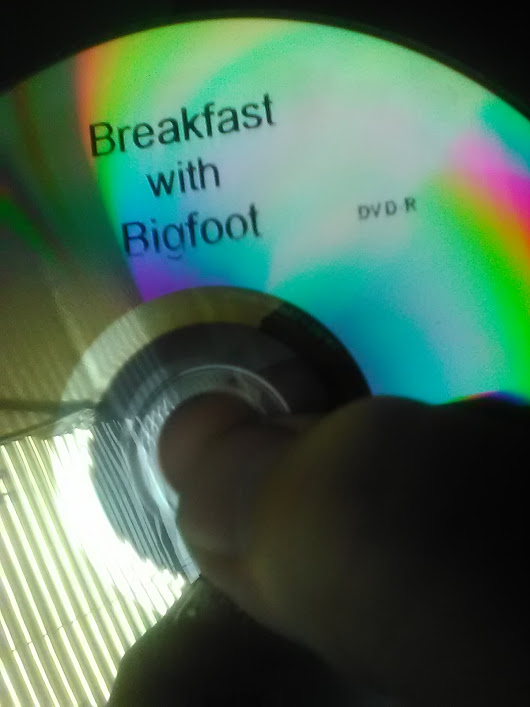
MY BREAKFAST WITH BIGFOOT

          In 1994, TV's A&E launched a new series called "Ancient Mysteries" with its flagship episode investigating Bigfoot. The show ran for four years, narrated mostly by Leonard Nimoy (twenty years after Nimoy narrated "In Search Of..."), but in this first show the narration credit goes to John Swanson. 
          It's an authoritative, well-produced documentary containing neat bits of info, such as the fact that President Theodore Roosevelt was convinced that the creatures we call Sasquatch exist. Unlike the majority of films discussed in this column, this Bigfoot documentary necessitates a rare departure. Ordinarily I never use the word "I" in an article. Yet the additional component to this one is that after watching the episode when first aired, I decided to conduct an interview of my own. 
          This is because the producers of the show sent a film crew to Hoopa. 
          "Here in the Hoopa Valley of Northern California," the narrator says, "Bigfoot sightings are common."
          Whereupon the show presents Hoopa Tribal elder Jimmy Jackson. And the first thing he does is refer to what his mother had always told him. 
          Soon after, we see Byron Nelson Jr. And he says, "I think it's real possible that something like that does exist." 
          At some point subsequent to these Hoopa speakers, we meet anthropology professor Grover Krantz, who points out that we already have a fourteen foot-tall Asian ape on the fossil record called Gigantopithecus. It is therefore reasonable to assume that what we call Bigfoot is a species descended from Gigantos. 
          However, Dr. Krantz wasn't in the telephone book. So I called Jimmy, introduced myself, told him I'd seen the TV show, and asked if I could meet him to ask questions about Bigfoot. We got along fine and Jimmy said yeah.
          I'd also asked if I could bring a friend with a Camcorder to record our interview. Not for a newspaper. Not for college. Just because I was interested.
          So Jimmy and I arranged a time, then my friend Tom and I showed up around ten one morning at Jimmy's place in Hoopa. 
          He was in his mid-eighties. Wore a cowboy hat. Used to be a logger. I noticed a bunch of acorns he had in boxes. He told us about the leeching process required in order to eat them. 
          Jimmy showed us pictures of his mother and told us about the Deer Dance. He said that when he was a kid, he and his friends used to climb cherry trees to pick cherries at school, and the teacher had a nail fixed to the end of a stick to jab up at the children in the tree when they weren't speaking English. 
          Turns out, Jimmy wasn't really an authority on Bigfoot. He didn't know, for example, about plaster casts of footprints found in remote areas with indentations in the casts of dermal ridges, whorls, standing up under professional scrutiny as impossible to fake. In fact, according to Texas Police Department Forensic Examiner Jimmy Chilcutt, the dermal ridges in casts he's seen fall between human and gorilla.
          Nor did Jimmy Jackson know much of anything about the famous Big-footage taken in 1967 by Roger Patterson and Bob Gimlin at Bluff Creek, near Eureka. 
          In the 952 frames of color film taken is the iconic shot where the Bigfoot is turning mid-stride. "Ancient Mysteries" does a good job presenting the evidence, but falls shy the mark by failing to mention what should be the most compelling and obvious evidence of authenticity available: which I'll get to in a moment.
          I realized during the interview (which I called, for no good reason, "My Breakfast With Bigfoot"), that Jimmy didn't know so much about Bigfoot. And he pointed out as much when the time came for us to go.
          But he also said, on his back porch, pointing toward the Klamath River, that his mother told him when she was young she had seen four of them come out of the forest and splash around in the river. A big hairy male, a big hairy female, and two hairy young ones. Not bears. Not people. What the Hoopa call Oma. Then they saw her. And they left.
          Some years later, I had my copy of that interview copied onto a disk. I contacted Byron Nelson Jr, with whom I had interviewed in the mid-'90s for the editorship of the Hoopa Valley Tribal Newsletter, and mailed him the disk so that Jimmy Jackson's family could have it. 
          To return to the Patterson film, what makes it particularly remarkable are the pendulous breasts. The fact that the movement of the muscles under the hide are impossible to fake is not so clearly evident to the layman as are the pendulous breasts. Interestingly, tellingly, every time this famous footage is referred to in t-shirts, hats, and sculptures, the breasts are automatically removed and the Bigfoot is made to be male. 
          We're supposed to believe that a former rodeo rider could make a suit better than the ones used years later in major motion pictures such as "2001: A Space Odyssey" and "Planet of the Apes", and we're supposed to believe he was the only one to buck the male Bigfoot rule, and that he decided to wear, for one time only and never again, a scientist-foolin' Bigfoot suit...with breasts?
          Gigantos already on the fossil record. 
          As the world's most famous primatologist, Dr. Jane Goodall, says on the subject (go to YouTube and have a listen), "You'll be amazed--I'm sure they exist!"
          By the way, zoom in on the right breast of the Patterson Bigfoot caught mid-stride and you can see areola nipple.
          It was around the time I mailed the disk copy of the interview that I happened to be talking with a Southern Humboldt County resident who wishes to remain anonymous, when he recounted to me something particularly interesting because I had never told him what Jimmy Jackson told me.
          According to the anonymous source, he was on his way to work one morning when he stopped off a mile or two south of Phillipsville at a pullout overlooking the Eel River. It was there that he saw four of them emerge from the forest on the other side of the river. A big hairy male, a big hairy female, and two hairy young ones. The same thing Jimmy's mother said she saw far to the north several decades earlier. 
          Then they saw him.
          And they left.


Stewart Kirby writes for
THE INDEPENDENT
and
TWO RIVERS TRIBUNE


Monday, October 29, 2018

"HALLOWEEN" SHAPES UP

       
          Forty years later, and still cutting-edge.
          John Carpenter's smash indie hit spawned sequels, inspired imitators, and established an iconic character so laconic he makes Eastwood's Man With No Name seem chatty.
          Carpenter derived his idea for the William Shatner mask-wearing, butcher knife-wielding Michael Myers, aka The Shape, in some measure from the girl in the 1960 film Eyes Without a Face. Equally essential to the filmmaker's aesthetic, and also from 1960, Alfred Hitchcock's Psycho.
          When Halloween was released, Psycho was regarded as the high-water mark of suspense. Carpenter pays the film homage by casting, in her first film, Jamie Lee Curtis, daughter of Janet Leigh, the star of Psycho.
          What Hitchcock did for taking showers, Carpenter almost did for babysitting.
          In this new vision, which scraps all of the films except for the first one, we find Michael Myers preserved in an asylum, where for forty years he has been a silent object of study. Researchers wanting to meet him even attempt to goad him. His being quiet and unable to express himself except with weapons once every few decades drives them crazy.
          To the young people in Haddonfield, the local legend of Michael Myers, who stabbed a handful of people Halloween night forty years prior (having  murdered his sister when he was six because she was brushing her hair topless in her room), pales in comparison to the customary violence of the world normalized in intervening years.
          Only Laurie Strode, who survived the violence, understands the danger involved in the event that Michael Myers ever gets free.
          Which he does.
          Echoes of Sarah Connor from Terminator 2 aside, Curtis' Strode is a self-described "basket case" obsessed with the need to never be a victim again. That said, her resolve extends to the women in her family--her daughter and her granddaughter. Whereas the 1978 movie showcased the "senseless violence" of a killer without a cause, the 2018 film concerns three generations of women uniting against an abuser.
          Unfortunately, John Carpenter isn't the director. (Although he and Curtis produced it.) Yet for that matter, he didn't direct Halloween 2 (1981). Whether the latter or this new vision takes second-place to the original is up for debate, but neither exceeds the source material.
          Fans of the franchise know what to expect from the hallowed lore: from the mildly curious tilt of Michael's masked head, to the inevitable demise of Unlikable Teens, Halloween digs deep into the cinematic bowl and freely disperses treat after treat, even managing to throw in a few surprises.
          Well worth the watch.


HALLOWEEN
Starring Jamie Lee Curtis,
Judy Greer,
Andi Matichak,
James Jude Courtney,
Nick Castle,
Haluk Bilginer,
Will Patton,
Jefferson Hall
Directed by David Gordon Green
Written by David Gordon Green, Danny McBride, Jeff Fradley
Based on characters created by John Carpenter, Debra Hill
Runtime 106 minutes


Stewart Kirby writes for
THE INDEPENDENT
and
TWO RIVERS TRIBUNE

Monday, October 22, 2018

WHAT THE ASTRONAUTS SAY


          According to Mercury 7 astronaut Gordon Cooper, in 1951, before he went into space, while flying an F-86 over Germany, he encountered a formation of "metallic-looking" craft:
          "There were a number of extraterrestrial vehicles out there kind of cruising around...they didn't have wings, they were saucer-shaped, and we never could get as high or as fast as they were," states Cooper. (To hear him, search "An Astronaut's UFO Experience - Gordon Cooper" on YouTube.) He further states that these craft were capable of maneuvers "that we couldn't do," such as "horizontally displace themselves rapidly."
          Several years later, in 1958, while working as a project manager at Edwards Air Force Base in California, Colonel Cooper had a film crew recording stages of an installation's construction when a small saucer "flew overhead and put down some landing gear and landed out on the dry lake bed only about fifty yards out." The cameramen started towards it, filming, "and with that it lifted up and put the gear back in and at a very high rate of speed disappeared."
          Cooper immediately had the film developed, following the protocol at the time required for such an event, in order to take it to Washington. Possession of it ran higher and higher up the chain of command. And that was the last he heard of the film evidence.
          In 1976, in an effort to disclose information on the UFO subject, Cooper wrote a letter to the United Nations wherein he stated, "There are extraterrestrial vehicles visiting from other planets."
          Nor is Gordon Cooper the only US astronaut to unequivocally affirm the answer to the UFO question.
          Apollo 14 astronaut Dr. Edgar Mitchell, Sixth man on the moon, on the subject of whether outer-space alien UFOs have been kept secret, states: "The question of has it been kept secret, or how could it be kept secret--it hasn't been kept secret. It's been there all along. But it's been the subject of disinformation in order to deflect attention and to create confusion so the truth doesn't come out." (To hear Dr. Mitchell, search "Astronaut Edgar Mitchell Testimony" on YouTube.)
          "Yes," says Mitchell, "there has been ET visitation."
          Apollo 15 astronaut Al Worden says the same thing.
          "We're the ones who come from somewhere else," says the man who flew around the moon 75 times, adding that people from somewhere else showed up and "started civilization here." (Search "Al Worden Apollo astronaut. We are the aliens.")
          Worden goes on: "If you don't believe me, go get books on the ancient Sumerians and see what they had to say. They'll tell you right up front."
          The land of the ancient Sumerians, by the way, is what we call Iraq.
          A skeptic, also by the way, is "a person inclined to question or doubt all accepted opinions." Therefore, because the mainstream has been fed the disinformation Dr. Mitchell discusses, it is the skeptical mind which doubts the official story which denies the truth affirmed by the astronauts.
          We are not alone. Alien UFOs are real. This is the testimony from the sources with the greatest credibility on the planet. They don't say that maybe UFOs are real. They say absolutely definitely.
          "This universe is limitless," says Col. Cooper. "We're kind of vain to think we're the only ones who exist here."


Check out also:

CHEMTRAIL DOCUMENTARY ILLUMINATING OVERALL
https://stewartkirby.blogspot.com/2015/11/chemtrail-documentary-illuminating.html


Stewart Kirby writes for
THE INDEPENDENT
and
TWO RIVERS TRIBUNE


Monday, October 15, 2018

"THEY LIVE" OUT OF SIGHT


          John Carpenter's heroic documentary on the exploitation of the working class masquerading as a sci-fi flick.
          According to Carpenter speaking on the topic of his 1988 visionary film, They Live was "mainly inspired by Ronald Reagan's conservative revolution."
          The film is "partly a political statement, partly a tract on the world that we live in," the director says, "and as a matter of fact it's even more true right now than it was then."
          Disgusted by the unrestrained capitalism of Reaganomics, and a culture "consumed by consumerism", the director of Halloween (1979), Escape From New York (1981), and The Thing (1982) "decided to scream out in the middle of the night and make a statement" about human values being pushed aside in the service of elitist greed.
          The resulting film stars Roddy Piper as a rough-hewn working-class hero who drifts into town and from the fringe finds a box of what look like regular sunglasses. However, he soon learns that by wearing these special lenses he sees the world around him as it truly is: a place where inhuman creatures pretending to be people enslave the masses through constant subliminal control.
          They Live, We Sleep. That's the writing on the wall. Literally.
          What appear to be billboards and magazines advertising toothpaste or perhaps spray cheese are actually hidden directives to OBEY and CONSUME, with the threat that REBELLION WILL NOT BE TOLERATED.
          It's a hard-hitting movie with rolls of quarters in the filmmaker's fists because the subliminal messages which the hero discovers are the same words used in real-life 1960s subliminal programming.
          Look it up. The old TV sign-off (back when TV used to stop for a few hours) which played the National Anthem in fact did used to contain those exact words, and more, presented in a very sneaky way. Eventually discovered, this particular trick got scrapped.
          Eleven years later, The Matrix follows suit. And while The Matrix is one of the greatest movies ever, They Live is simply much more pure. In a sense, the least realistic aspect to it is the abundant proliferation of alien enslavers in humanity's midst. One percent just doesn't look like that.
          Among the film's many notable features, its protagonist was the first professional wrestler to star in a number one box-office release. Rowdy Roddy Piper (who died three years ago) proved that he can act. He also personally wrote the film's most memorable line: "I have come here to chew bubblegum and kick ass...and I'm all outta bubblegum."
          The 6-minute fight scene with Keith David (Kurt Russell's co-star in The Thing) is the brawl of legend, and a brilliant decision on Carpenter's part because it focuses the conflict on making one's fellow unwitting accomplices see the true reality all around.


THEY LIVE
Starring Roddy Piper,
Keith David,
Meg Foster,
George "Buck" Flower,
Peter Jason,
Raymond St. Jacques
Directed by John Carpenter
Written by John Carpenter (as Frank Armitage)
Based on a story by Ray Nelson
Runtime 94 minutes
Rated R


Stewart Kirby writes for
THE INDEPENDENT
and
TWO RIVERS TRIBUNE