Monday, January 28, 2019

"EXCALIBUR" MEDIEVAL MOVIE HOLY GRAIL


          Authoritative, sober, grounded in mythology, John Boorman's Excalibur (1981) is the tale of the Sorcerer, Merlin, the Coming of a King, and the Sword of Power.
          Recent attempts at King Arthur and also Robin Hood in film totally botched it and tanked hard because, as even merely the trailers clearly reveal, the filmmakers give zero attention to authenticity and literary grounding.
          Excalibur flat-out looks and sounds exactly right. Lots of hacking and screaming, nobody pulling any modern mixed martial arts moves flying around on cables, none of that phony computer animation look, just real filmmaking with a filmmaker's eye crafting the frames.
          Boasting great music by Richard Wagner and Carl Orff--the latter being responsible for the famous "O Fortuna" piece from Carmina Burana--Excalibur is the tale of power, lust, and deception woven into the very fabric of Western culture.
          It begins with Uther Pendragon (Gabriel Byrne) coveting Igrayne (played by the director's daughter, Katrine Boorman), the wife of the Duke of Cornwall. With a wizard's help, Uther gets his wish, but the product of this union must go to the wizard.
          The product is Arthur (Nigel Terry), and the wizard is of course Merlin (excellently played by Nicol Williamson). Long before Dumbledore or even Gandalf, there was Merlin. The Disney cartoon The Sword and the Stone, based on T.H. White's The Once and Future King, presents a silly curmudgeon as out of keeping with the character as the youthful "early years" presentation in a recent TV show. Williamson's portrayal of the Druid-like figure has the right balance of eccentricity and mystery.
          Williamson, by the way, plays Little John to Sean Connery's Robin Hood in the fantastic 1976 movie Robin and Marian, also starring Audrey Hepburn.
          Excalibur features terrific supporting performances by Liam Neeson and Patrick Stewart as Knights of Camelot, and features also Helen Mirren as Arthur's evil half-sister, Morgana.
          The Dark Ages, of course, refers to a few centuries in Europe following the collapse of the Roman Empire. On the one hand the tale of King Arthur is the story of a sun god who enlightens, descends, and will return. So Arthur's Round Table not only heralds the coming of pizza, it signifies equality, justice, and order.
          Boorman, who also directed Hell in the Pacific, Deliverance, and The Emerald Forest (starring his son Charley), was likely influenced by John Steinbeck's last and unfinished book, The Acts of King Arthur and His Noble Knights, for which Steinbeck studied Thomas Malory's Le Morte d'Arthur. Conceivably, Boorman, jealous of Monty Python and the Holy Grail (1975), tried his best to make a funnier version, and simply failed. We'll never know.
          Quest for the fair Guenevere, the unbeatable Lancelot, the well-armed Lady of the Lake, nasty little Mordred, and the whole Excalibur gang online through Netflix and other sources.


EXCALIBUR
Starring Nigel Terry,
Helen Mirren,
Nicol Williamson,
Nicholas Clay,
Cherie Lunghi,
Paul Geoffrey,
Robert Addie,
Liam Neeson,
Patrick Stewart
Directed by John Boorman
Written by Rospo Pallenberg, John Boorman
Based on Le Morte d'Arthur by Thomas Mallory
Runtime 140 minutes
Rated PG


Stewart Kirby writes for
THE INDEPENDENT
and
TWO RIVERS TRIBUNE


Monday, January 21, 2019

HERZOG'S "CAVE" IN-DEPTH


          In 1994 three men found a cave in France with 32,000 year-old paintings inside, which is more than twice as old as the previous oldest cave paintings known.
          At some point in its history, a landslide sealed off the cave, creating a time capsule.
          At the time of the renown German filmmaker Werner Herzog's visit to Chauvet Cave with a camera crew, we see the entrance to the cave protected by a massive steel door "like a bank vault."
          Lascaux Cave, well-known worldwide for the similar paintings by Paleolithic artists, was shut down because tourist breath caused mold to grow on the walls.
          Herzog's visit to Chauvet is limited by a time constraint and the stipulation that no one touch anything inside the cave, nor step off of the two foot-wide metal walkway.
          Inside, painting of animals "look so fresh, there were initial doubts to their authenticity."
          Mammoths, cave bear, horses, bison, lions, and more dance across the walls, contours of the rock taken into account to create greater effect.
          The play of light and shadow from flickering torches might have been intended by the artists to help bring the renderings to life, but in some cases illusions of movement were definitely included. A bison on one panel painted with eight legs gives the impression of movement in nearly "a form of proto-cinema," and a wooly rhino with lines of multiple horns looks "like frames in an animated film."
          Using lasers, scientists have mapped the cave so well, the "position of every feature in the cave is known."
          We see wavering lines of delicate rock curtains, stalactites and stalagmites shining with otherworldly crystals, cave bear skulls littering the floor covered in tens of thousands of years of calcite deposits incorporating the bones like candle wax. For the viewer, Cave of Forgotten Dreams is an opportunity to visit the past without hurting it.
          In his 71 films, Herzog, who was born in Bavaria, has directed such other notable documentaries as Encounters at the End of the World (2007), his Antarctic adventure, and Wheel of Time (2003), wherein Herzog goes to India to film the world's largest Buddhist ritual.
          In addition to making unforgettable documentaries, Herzog directs major motion pictures featuring intense performances, such as Aguirre, Wrath of God and Rescue Dawn.
          To see "one of the greatest works of art in the world" through the camera of the visionary auteur, look for the 2010 film available on Netflix.


CAVE OF FORGOTTEN DREAMS
Starring Werner Herzog,
Jean Clottes,
Julien Monney,
Jean-Michel Geneste,
Michel Philippe,
Carole Fritz,
Dominique Baffier
Written and directed by Werner Herzog
Runtime 90 minutes


Stewart Kirby writes for
THE INDEPENDENT
and
TWO RIVERS TRIBUNE


Monday, January 7, 2019

"NIGHT OF THE HUNTER" CAPTIVATING NOIR


          A father of two robs a bank during the Great Depression. Just before the cops can nab him at his house, the dad (played by Peter Graves) hides a wad of money and tells his kids, John and Pearl, to never reveal its location.
          However, while in jail, he meets a man named Harry Powell (Robert Mitchum). When Powell, who calls himself Preacher, gets wind of the missing money, he becomes obsessed with relieving John, Pearl, and their beautiful mother (Shelley Winters) of the $10,000 in loot.
          To achieve this end, Powell carries a switchblade which he calls a "sword" and has conversations with the Lord about smiting widows in Holy Battle.
          Night of the Hunter (1955), directed by one of film's greatest actors, Charles Laughton, is a gem of a picture concerning sex, money, religion, and murder all in one.
          As Harry Powell, Robert Mitchum is perfectly cast. When asked what religion he claims to preach, Powell growls, "The religion the Almighty and me worked out betwixt us!"
          It's the movie where Mitchum sports tattoos on his knuckles proclaiming LOVE and HATE. An "inwardly ravening wolf," Powell's not just out for money, he's legitimately nuts at all times. He hates women, and reminds God during their one-sided chats how God hates "perfume-smellin' things," too.
          Another character spends a deal of time talking to God and she's played by Lillian Gish, one of film's first stars, famous among other things for her role in D.W. Griffith's Way Down East (1920).
          The attractive widow of the bank robber, excellently played by Shelley Winters, bends God's ear in her own way, praying for "cleanliness" in the eyes of a supposed preacher who's killed around a dozen widows.
          Many of the shots that are intended to be outdoors clearly aren't. For whatever reason--probably greater filmmaking control--several scenes require indoor studio setup prevalent in cinema. Doesn't help the general look to suddenly see fake river. But there it is.
          As a film about repression released in particularly repressive times, it (or rather Laughton) gets away with a lot. The matronly Mrs. Spoon waxes philosophic at a church picnic on the subject of women wanting sex and concludes that sort of fiddle-faddle is "just a pipedream" and maintains that in all those years with Mr. Spoon she just thinks about her canning.
          Speaking of pipes, Mitchum liked smoking his. Got arrested for marijuana possession in 1948, and on the strength of that became extra-famous as Hollywood's sleepy-eyed, badass stoner. Less well-known: The screenplay for Thunder Road (1958), in which Mitchum starred, was based on a story he himself wrote about a Korean War vet's attempts to make moonshine.
          Stanley Kubrick seems to have been inspired by the film. Comparisons between Jack Torrance and Harry Powell abound. Look for Mitchum also as a great bad guy chasing around Gregory Peck and family in the 1962 film Cape Fear.


THE NIGHT OF THE HUNTER
Starring Robert Mitchum,
Shelley Winters,
Lillian Gish,
James Gleason,
Evelyn Varden,
Billy Chapin,
Sally Jane Bruce,
Peter Graves
Directed by Charles Laughton
Written by James Agee
Based on the novel by Davis Grubb
Runtime 92 minutes


Stewart Kirby writes for
THE INDEPENDENT
and
TWO RIVERS TRIBUNE


Saturday, December 29, 2018

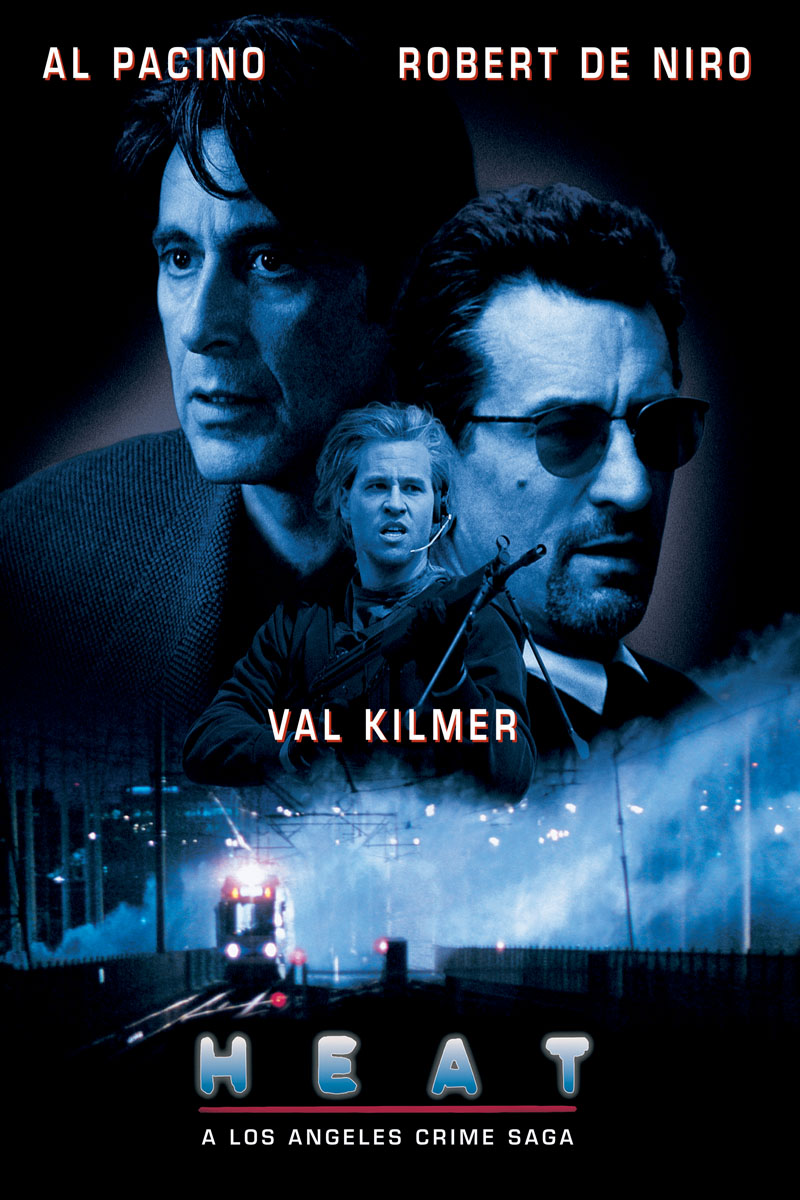
"HEAT" INCENDIARY


          Michael Mann's crime-drama masterpiece.
          From the director of The Last of the Mohicans this riveting story about an LAPD detective who puts the heat on a crack crew of heisters.
          Boasting a stellar cast, top-notch writing featuring clear, believable characters, intense action, and a great visual style, Heat (1995) is as much a thrill-ride as it is a lesson in the art of acting.
          One great thing Mann does is present a strong supporting cast casting against type. This blurs the lines and creates dimensionality to see actors famous for bad guy roles as the detectives hunting down the heisters. You don't want Scarface, Jame Gumb, and Magua out to get you.
          Not even if you're Jim Morrison. Val Kilmer plays the amiable tactical weapons specialist and personal friend of the mastermind, Neil McCauley (De Niro). Tom Sizemore and Danny Trejo round out Neil's core squad.
          Mann marbles in just the right amount of attention to the relationships of the characters, specifically the wives and girlfriends. Impaired by the severity of their partners' work, the women on both sides of the law are shut down from communicating, yet wind up being the redeemers of obsessed men.
          As Neil, De Niro is razor sharp, very controlled. His mistake is to take a new guy into a job, and maybe to allow himself to get close to anyone.
          Opposite him, Pacino is in standard rare form. In a scene where the lieutenant he plays is trying to find out something from an informant, Pacino suddenly explodes with the demand for the guy to tell him everything he knows, explodes in a way that could not be written on the page. Just one of many great moments showcasing the art of bringing the story to life.
          When the detective played by Ted Levine simply uses a pen as a pointer at a crime scene, it's incredible to remember he's the same actor famous as Buffalo Bill from The Silence of the Lambs.
          Ashley Judd, Henry Rollins, Tone Loc, Hank Azaria--disparate talent supporting established heavyweights. Ultimately, we know it's a showdown between Pacino and De Niro. The mutual respect the two characters develop for each other speaks at a weird meta-level to the respect we like to feel must be shared by the formidable thespians for each other.
          "At the drop of a hat," the lieutenant assures his men, "these guys will rock and roll."
          According to IMDb, Mann began his career writing for Starsky and Hutch, so it was very much in his skill-set when in 1984 he created his own successful buddy-cop TV show, Miami Vice. In 1986 he directed Manhunter, the first film to feature the character Hannibal Lecter.


HEAT
Starring Al Pacino,
Robert De Niro,
Val Kilmer,
Tom Sizemore,
Ashley Judd,
Ted Levine,
Wes Studi,
Natalie Portman,
Jon Voight
Written and directed by Michael Mann
Runtime 170 minutes
Rated R


Stewart Kirby writes for
THE INDEPENDENT
and
TWO RIVERS TRIBUNE


Sunday, December 23, 2018

"HARD DAY'S NIGHT" DRUMS UP TRUMPETING


          The best of the movies starring the world's best band is a lighthearted and zany lark, a decades-earlier "Seinfeld"-esque "show about nothing" beautifully shot in black and white.
          Top-notch photography and innovative filmmaking give A Hard Day's Night (1964) a classy look. From the clang of the opening note of the film's title song, John, Paul, George, and Ringo are in motion--specifically attempting to escape the mobs of shrieking fans.
          It's a musical unlike any other because it's a slapstick comedy combined with a sort of documentary, true in the sense of accurately recording the inarticulate excitement of youth culture for the Beatles. Also unique in that most musicals require the bizarre conceit of groups of people suddenly breaking into songs and dances in stagey ways.
          Not so here.
          For the Beatles, playing themselves necessitates musical performances, and ultimately a televised concert in front of a genuinely ecstatic studio audience.
          As a subplot to this, Paul's grandfather (Brambell) is a little old man, very clean, who requires constant supervision because he is, in Paul's words, "a villain."
          Paul's grandfather, like all of the older folk in the film, acts childishly and can not be trusted to behave properly. When an old man discovered in a cupboard wants to accompany the Fab Four down to the hotel casino to find Paul's grandfather, John has to tell him no, "You're too old!"
          When asked at a press luncheon, "Are you a mod, or a rocker?" without missing a beat, Ringo replies, "I'm a mocker."
          Reporter: "What would you call that hairstyle you're wearing?"
          George: "Arthur."
          As a sub-subplot, Paul's grandfather, being a "king mixer", tweaks Ringo's inferiority complex, assuring him that fans will "pick on" Ringo's nose.
          Upbeat flick that it is, A Hard Day's Night features full song performances and incomplete portions woven frequently in, including "I Should Have Known Better", "And I Love Her", "Can't Buy Me Love", and many more.
          Help! (1965) is the other classic (although not quite as good) catching the Lads From Liverpool in the act of being fun and silly. Let It Be (1970), not a wacky slapstick, is the documentary that accidentally records the beginning of the end for the band.
          Director Richard Lester a decade later directed the excellent Three Musketeers films featuring Michael York, Raquel Welch, Charlton Heston, and an all-star cast.
          The timeless trendsetter freely available online.


A HARD DAY'S NIGHT
Starring John Lennon,
Paul McCartney,
George Harrison,
Ringo Starr,
Wilfrid Brambell,
Norman Rossington,
John Junkin,
Victor Spinetti,
Anna Quayle
Directed by Richard Lester
Written by Alun Owen
Runtime 87 minutes
Rated G


Stewart Kirby writes for
THE INDEPENDENT
and
TWO RIVERS TRIBUNE

Click link to books:
https://www.amazon.com/Stewart-Kirby/e/B00572M8JC


Monday, December 17, 2018

"DRIFTER" RIDES HIGH


          Clint Eastwood's mostly ghostly Western.
          In the tiny town of Lago (means lake), at the edge of the world where gulls caw, a lone rider in the hazy heat shimmers into view like a horseman from hell.
          Small, isolated town though it be, Lago has officials. Nervous, sweaty officials considering hiring a gunslinger to protect them from three outlaws on their way to settle a score. So when a mysterious stranger (Eastwood) appears and shows his handiness with arms, the townspeople (who carry a dark secret) decide to give the stranger whatever he wants in order to protect them.
          But the stranger has his own agenda.
          High Plains Drifter (1973) is the second motion picture directed by the iconic actor, and his first Western. (In 1971 he directed and starred in the excellent thriller Play Misty For Me.)
          The cinematic premise of the gunslinger ostensibly defending the town while actually looking out for his own needs goes back to Akira Kurosawa's Yojimbo (1961), wherein a crafty masterless samurai played by Toshiro Mifune plays rival towns against each other. That was re-made in Italy by Sergio Leone as A Fistful of Dollars (1964) and starred Eastwood as the Man With No Name character who appeared twice more in sequels--For a Few Dollars More (1965) and The Good, the Bad, and the Ugly (1966).
          Eerie music with a sort of "tortured soul choir" lends a spectral atmosphere unique to the genre. Several aspects of the film set Drifter apart from the Western herd. Prior to the emergence of Clint (in the late-'50s he played Rowdy Yates on TV's Rawhide), the lead in a Western was much more "white hat-ish".
          We see the events which account for the mysterious gunslinger's vengeful spirit through flashbacks of a Marshall Duncan receiving a group bullwhipping in the street at night.
          "Damn you all...to hell," he barely manages to hiss. Sometimes, that's all it takes.
          Death by group bullwhipping, the most tragic way to go. Strangely, although we are able to see it's Clint being disciplined, somehow none of the townspeople recognize him. Not even the little person, Mordecai (Curtis), whom the stranger makes sheriff. And mayor.
          "What did you say your name was again?" Mordecai asks lighting a match for the stranger. (Mordecai is a Hebrew boy's name meaning "warrior", by the way, and Duncan is an Anglicized form of a Gaelic name which can be taken to mean "dark warrior".)
          To which the stranger hisses, "I didn't."
          Well, he doesn't do a lot of things. For instance, he doesn't last more than literally 40 seconds with a woman he abuses in a barn. Sleazy downer scene aside, most of the film is entertaining as hell.
          For one thing, everybody except for Clint shines from excessive sweat. None more so than the barber with the shaky hands and the greasy strands of combover slicked across his sweaty head.
          Gradually the tight-knit dysfunctional townspeople realize that their new solution may be worse than the original problem. But at that point it doesn't matter, because the stranger's decided to paint the town red!
          Look for Eastwood's latest film The Mule, which he directs and stars in, about a 90 year-old horticulturalist who becomes a mule for a Mexican drug cartel. In theaters now.


HIGH PLAINS DRIFTER
Starring Clint Eastwood,
Verna Bloom,
Mitchell Ryan,
Billy Curtis,
Geoffrey Lewis,
Stefan Gierasch,
Jack Ging,
Marianna Hill,
John Hillerman,
William O'Connell
Directed by Clint Eastwood
Written by Ernest Tidyman
Runtime 105 minutes
Rated R


Stewart Kirby writes for
THE INDEPENDENT
and
TWO RIVERS TRIBUNE
Click link to books:
https://www.amazon.com/Stewart-Kirby/e/B00572M8JC


Monday, December 10, 2018

"BRAZIL" SHINING CINEMATIC SWORD


          The story of Terry Gilliam's career as a director is to make a brilliant movie, watch it go over audience's heads, receive filmmaker's probation because it didn't bring in enough money, then watch it become a cult favorite.
          Brazil (1985) is the former Monty Python member's dystopian masterpiece (one of two, actually, the other being 12 Monkeys). Jonathan Pryce (Gov. Swan in the Pirates of the Caribbean franchise) plays Sam Lowry, a nebbish dreamer trapped in a dark and lonely world of obedient, lifeless functionaries.
          The drab 1930s retro-future aesthetic, replete with automaton-like office personnel, calls George Orwell to mind. A prescient film from a visionary artist, if Brazil has lost any impact 33 years later, it's because now it hits too close to home.
          Think Orwell meets Kafka, only funnier.
          In a world of TVs everywhere, and helpful Fatherland reminders such as DON'T SUSPECT A FRIEND, REPORT HIM, and SUSPICION BREEDS CONFIDENCE, Sam Lowry dreams of flying in a shiny metal suit with big godly hair, spreading his mechanical wings and turning somersaults in the clouds, a majestic superhero of love free to live a fulfilling life--until he wakes up again and has to get shoved around in the stifling nightmare of ducts and hoses and bungled procedures.
          An alarmingly simple clerical error results in the Secret Police storming into an innocent family's apartment and taking the dad away in chains. They were looking for a Tuttle and instead they got a Buttle. A neighbor asks if the mom with the kids and the abducted husband is okay, and immediately the Secret Police start shooting.
          "That is your receipt for your husband. And this is my receipt for your receipt."
          When asked on TV to what he attributes the rise in terrorist attacks, the Deputy Minister proclaims, "Bad sportsmanship!"
          "The bombing campaign is now in its 13th year."
          "Beginner's luck!"
          Blackly comic images of surreal satire abound: a tug-of-war with a desk shared between two closet-size office rooms, a secretary with mechanical assistance connected to her flesh transcribing cries of anguish from ongoing torture like a court reporter.
          Featuring an all-star supporting cast including Robert De Niro, Ian Holm, Katherine Helmond, Jim Broadbent, Bob Hoskins, and Michael Palin. Plus stunning, perpetually rewarding visuals and a musical leitmotif as ironic and dissonant as Kubrick's use of "We'll Meet Again" in Dr. Strangelove.
          As his daydream self, keen of eye and swift with shining sword, Lowry sees a recurring beautiful woman. What happens when he meets in the actual grimy world a woman who looks just like his dream girl and who fights the dystopian state of the Faustian future is the story that reminds us, "We're all in this together!"


BRAZIL
Starring Jonathan Pryce,
Robert De Niro,
Ian Holm,
Kim Greist,
Katherine Helmond,
Jim Broadbent,
Bob Hoskins,
Michael Palin
Directed by Terry Gilliam
Written by Terry Gilliam, Tom Stoppard,
Charles McKeown
Runtime 132 minutes
Rated R


Stewart Kirby writes for
THE INDEPENDENT
and
TWO RIVERS TRIBUNE